|
|||||||||||||||||||||
Princeton Satellite |
This product is used worldwide by leading research and development organizations and spacecraft manufacturers. Over one thousand functions are provided for attitude and orbit simulation, analysis and design. You can design a satellite using the graphical CAD tools; design and analyze the control systems; perform disturbance analyses and test the control system in simulation - all in the MATLAB environment. Modular organization of the Toolbox integrates the formerly separate Stellar, Orbit, and Spin-Axis Toolboxes, and enables customers to add the functionality they want when they want to. The new Autonomous GN&C Module is the only complete GN&C system commercially available in the world.
Princeton Satellite Systems has used this toolbox over the past decade to design the Indostar/Cakrawarta-1 geosynchronous communications satellite attitude control system; the TDRS momentum management system; formation flying systems for NASA/GSFC and on many other projects. Many of the tools are the product of our own research and development and are not available anywhere else! Extensive documentation, including a 400 page theory manual, is included. Bestandteile der SpaceCraft Control Toolbox Version 9Die Toolbox besteht aus dem Core-Modul und drei zusätzlich erhältlichen Modulen: Formation Flying, Solar Sail und Spin Axis Attitude Determination. Das Core Modul enthält sowohl die Core Toolbox Funktionen Common, Plotting, SC und SCPro als auch die speziellen Analyse- und System-Module
Zusätzliche nicht in der Core-Version enthaltene Module sind:
For additional information, try the following links: SCT Core Toolbox v9The Spacecraft Control Toolbox, for use with MATLAB®, is used worldwide to design, simulate and analyze spacecraft control systems; it is the product of more than twenty years of design experience including Mars Observer, GGS Polar, Inmarsat 3 and GPS IIR. Princeton Satellite Systems has used it for the past decade to support various major government and corporate contracts. This includes the Indostar/Cakrawarta-1 geosynchronous communications satellite attitude control system, the TDRS momentum management system and many others.
Applications
Key FeaturesThe Spacecraft Control Toolbox provides a comprehensive suite of modules capable of:
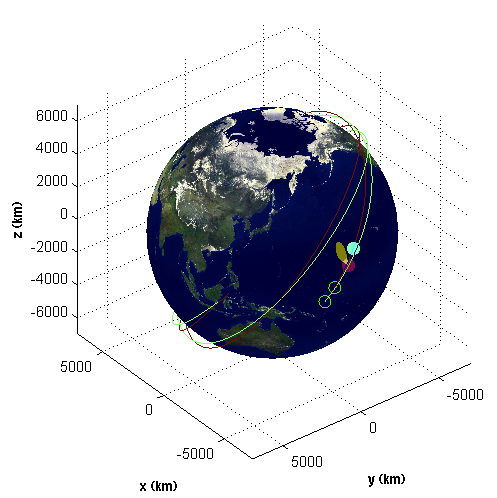
ExamplesPivoted Momentum Wheel for Nutation DampingA pivoted wheel on a momentum bias spacecraft can be used to damp nutation. In theory one pivot movement can damp nutation and two movements can correct for an attitude offset and nutation. The plot on the right shows the effect of a manual pivot movement timed perfectly. Nutation is fully damped! As any of you who might have operated spacecraft, this can be quite hard to do in practice! Pulsewidth ResolutionThe minimum pulsewidth of thrusters presents a major challenge to designers of thruster control systems. Usually the minimum pulsewidth is around 20 msec and for small spacecraft that is a significant torque impulse. The plot to the right shows different methods of dealing with the resolution problem. The ideal case is shown as is the case where there is not compensation for minimum pulsewidth. The two methods that work reasonably well are applying triangle wave dither, which should ideally eliminate the nonlinearity, and applying a variable pulsing period. In the latter you donÕt fire your thrusters every control period. Rather you undersample and fire once every few control samples. This works well but you must be careful to account for the new, longer, zero-order hold in your design! Visualization and SimulationThe CAD tools allow very elaborate visualization. The figures to the right show a simulation of the Space Shuttle Orbiter with the Remote Manipulator being deployed. You can build models, which can include multiple components as shown here, and animate each component. Besides animation, you can simulate multi-body models, compute disturbances for those models and connect controllers to the models. |
||||||||||||||||||||
|
|
|||||||||||||||||||||